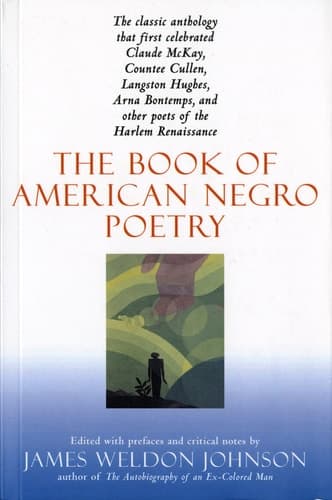
The Book of American Negro Poetry
James Weldon JohnsonPublished1983
Pages300
Formatpaperback
PublisherHoughton Mifflin Harcourt
Synopsis
A landmark anthology of forty poets that brought serious attention to writers such as Countee Cullen and Langston Hughes. The poetry, the prefaces, and Johnson's critical notes have made this book a classic. Indices.
Recommendations

The Souls of Black Folk and Clotel By W.E.B. Du Bois
by DuBois Blight Gooding Bro
Du Bois was writing essays and cultural criticism during the exact same era Johnson was curating this anthology, and his collection shares that urgent need to document and defend Black intellectual life against dismissal. Where Johnson's preface argues for the legitimacy of Black poetry, Du Bois is making parallel arguments about Black identity itself—they're companion pieces in a larger conversation about representation and dignity.
View book
Ralph Ellison - Invisible Man
by Anke Balduf
Ellison's novel does something Johnson's anthology does structurally: it layers voices, perspectives, and competing narratives about what it means to be seen and unseen in America. The protagonist's journey mirrors the anthology's implicit argument—that Black artistic expression is both deeply personal and inevitably political, and that the act of speaking itself is an act of claiming existence.
View book
One Day, when I was Lost A Scenario Based on Alex Haley's "The Autobiography of Malcolm X"
by James Baldwin
This is a surprise pivot into nonfiction, but hear me out: Malcolm X's autobiography is essentially a performance of voice and self-creation, much like the poets Johnson collected were performing their identities on the page. Both texts are about claiming authority over your own narrative, and both insist that intellectual rigor and artistic expression are acts of resistance—Malcolm's speeches have the cadence and power of the best poetry in Johnson's collection.
View book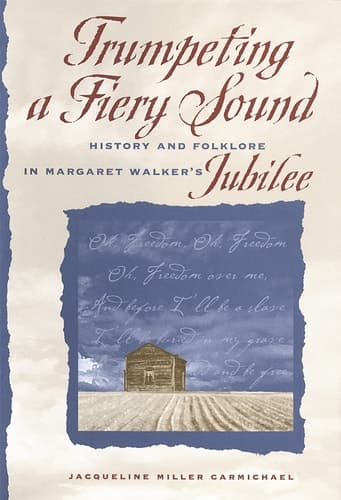
Trumpeting a Fiery Sound History and Folklore in Margaret Walker's Jubilee
by Jacqueline Miller Carmichael
Walker was herself a poet (and would have been publishing during Johnson's lifetime), but this novel weaves poetry's sensibility into historical narrative—it reads like an extended meditation on how Black lives persist and endure across generations. The book has the lyrical intensity and attention to language you'd find in Johnson's anthology, but stretched across a century of a woman's life, giving you a different way to experience that same poetic consciousness.
View book
The Collected Poems of Paul Blackburn
by Paul Blackburn
Dunbar was a predecessor to many of the poets Johnson championed, and while he might seem like an obvious choice, his collected works deserve a full reading rather than anthology sampling. Johnson's preface actually discusses the challenge Dunbar faced—writing in dialect while proving his sophistication—and reading Dunbar's full range shows exactly why Johnson felt compelled to make his case for the poets who came after him. It's the historical foundation that makes Johnson's anthology necessary.
View bookAbout James Weldon Johnson
J
James Weldon Johnson
1873–1954
John Rosamond Johnson (August 11, 1873 – November 11, 1954; usually referred to as J. Rosamond Johnson)[1] was an American composer and singer during the Harlem Renaissance. Born in Jacksonville, Florida, he had much of his career in New York City. Johnson is noted as the composer of the tune for the hymn "Lift Every Voice and Sing". It was first performed live by 500 Black American students from the segregated Florida Baptist Academy, Jacksonville, Florida, in 1900.[2] The song was published by Joseph W. Stern & Co., Manhattan, New York (later the Edward B. Marks Music Company).[3] -Wikipedia
View author page