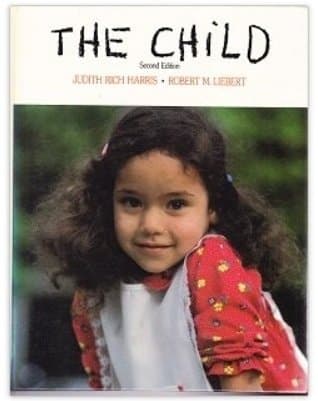
The Child Development from Birth Through Adolescence
Judith Rich HarrisPublished1987
Pages585
Formathardcover
PublisherPrentice-Hall
Synopsis
Abstract: The authors' goals for this book are two fold: 1) to provide a complete, accurate description of child growth and development from conception through late adolescence and; 2) to make the information clear and accessible to all readers, especially to those with no previous knowledge of child development and related topics. While the intent is to focus on normal child development, problems in development appear in set apart text and cover developmental difficulties that may occur. The authors present their own theory of development which is transactional along with early and prevailing theories of child development (Locke, Rousseau, Darwin, Erikson, Piaget, Skinner). The first three chapters of the book cover basic development concepts, heredity and environment and important theories of development. Chapters four through fifteen are arranged chronologically beginning with conception.
Recommendations
The Developing Child
by Helen L. Bee
Bruner takes the same chronological, stage-based approach Harris uses but filters it through his theory of cognitive scaffolding—how children actively construct understanding rather than passively receive it. If you appreciated Harris's clear synthesis of major theories, you'll find Bruner's framework adds a crucial dimension about *how* learning actually happens at each developmental stage.
View book
The Nurture Assumption: Why Children Turn Out the Way They Do : Parents Matter Less Than You Think and Peers Matter More
by Judith Rich Harris
I know—same author, but this is Harris's provocative counterargument to her own textbook. Where the developmental text presents the consensus view, this book challenges the assumption that parenting style is destiny, arguing peer groups matter far more than we think. It's the intellectual sequel that questions some of the foundational premises you just learned.
View book
The Boy Who Was Raised as a Dog And Other Stories from a Child Psychiatrist's Notebook--What Traumatized Children Can Teach Us About Loss, Love, and Healing
by Bruce Perry
Perry translates developmental neuroscience into case studies—real children whose brains were shaped by trauma, neglect, or recovery. Where Harris gives you the textbook framework, Perry shows you what happens when development goes sideways and how understanding those mechanisms actually helps clinicians intervene. It's developmental psychology meeting real clinical practice.
View book
Alex Haley's The Autobiography of Malcolm X
by Anita J. Aboulafia
Here's your genre-jump: a memoir that's also an inadvertent case study in identity development across adolescence and adulthood. Reading Malcolm X's account of his own transformation—prison education, ideological shifts, evolving self-concept—gives you the lived texture of developmental theory. It shows how the abstract stages Harris describes actually *feel* when you're living through them.
View book
How Children Develop
by Robert S. Siegler
Bjorklund brings evolutionary psychology into the conversation—asking not just *how* children develop, but *why* they develop the way they do from a survival perspective. If Harris's transactional model intrigued you, Bjorklund's evolutionary lens adds another layer: development as adaptive solutions to ancestral problems, which reframes everything you just learned.
View bookAbout Judith Rich Harris
Biography coming soon.
View author page