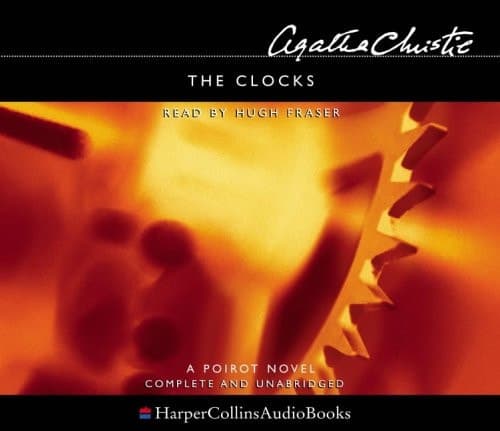
The Clocks Complete & Unabridged
Agatha ChristiePublished2004
Formataudiobook
PublisherHarpercollins Pub Ltd
Synopsis
Sheila Webb, typist-for-hire, has arrived at 19 Wilbraham Crescent in the seaside town of Crowdean to accept a new job. What she finds is a well-dressed corpse surrounded by five clocks. Mrs Pebmarsh, the blind owner of No. 19, denies all knowledge of ringing Sheila’s secretarial agency and asking for her by name — yet someone did. Nor does she own that many clocks. And neither woman seems to know the victim. Colin Lamb, a young intelligence specialist working a case of his own at the nearby naval yard, happens to be on the scene at the time of Sheila Webb’s ghastly discovery. Lamb knows of only one man who can properly investigate a crime as bizarre and baffling as what happened inside No. 19 — his friend and mentor, Hercule Poirot.
Recommendations
The Moonstone, by Wilkie Collins
by Jean-Pierre Naugrette
Collins essentially invented the detective novel with this one, and it shares Christie's delight in layering clues so that the reader can theoretically solve the mystery alongside the investigators. Where The Clocks gives you Poirot's methodical brilliance, The Moonstone gives you multiple narrators each convinced they've spotted the culprit—it's a puzzle box within a puzzle box, and you'll find yourself constantly revising your theories, just as you did with those five mysterious clocks.
View book
The Tuesday Club Murders
by Agatha Christie
Osman writes mysteries with the same architectural precision as Christie—every detail matters, every character has secrets—but he's also genuinely funny in a way that lets you enjoy the investigation even when you're completely lost. The setup involves amateur sleuths in a retirement village investigating a real murder, and there's that same pleasure of watching ordinary people apply logic to the extraordinary, though Osman's tone is warmer and more character-driven than the clinical brilliance you get from Poirot.
View book
Reading The Water (David Hughes Fishing Library)
by Dave Hughes
Here's your surprise pick: this is narrative nonfiction about a 1740s naval court-martial, but it reads like the most intricate mystery novel you've ever encountered. Mametsch reconstructs two completely contradictory accounts of the same events from primary sources, and you're left doing exactly what you did with The Clocks—weighing testimony, spotting inconsistencies, trying to determine what actually happened. It's Christie's puzzle-solving methodology applied to real history, and the obsessive detail work will absolutely satisfy that part of your brain that loves tracking clues.
View book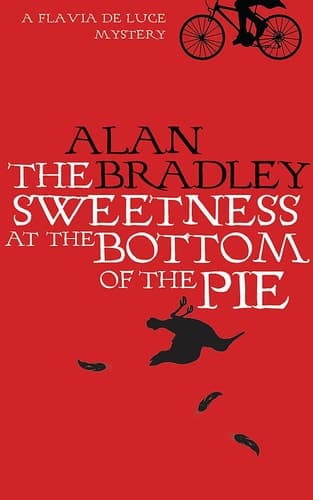
The Sweetness at the Bottom of the Pie
by Alan Bradley
Bradley's Flavia de Luce is what you'd get if you gave an eleven-year-old chemistry prodigy Poirot's deductive method and set her loose in 1950s England. The mystery itself—involving a dead man in the cucumber patch—has that same 'how did this happen in broad daylight?' quality as The Clocks, but Flavia's voice is so distinctive and her approach so unconventional that it feels fresh even though the bones of the puzzle are classically constructed.
View bookAbout Agatha Christie
A
Agatha Christie
1890–1976
Agatha Mary Clarissa Miller was born in Torquay, Devon, in the United Kingdom, the daughter of a wealthy American stockbroker. Her father died when she was eleven years old. Her mother taught her at home, encouraging her to write at a very young age. At the age of 16, she went to Mrs. Dryden's finishing school in Paris to study singing and piano. In 1914, at age 24, she married Colonel Archibald Christie, an aviator in the Royal Flying Corps. While he went away to war, she worked as a nurse and wrote her first novel, The Mysterious Affair at Styles (1920), which wasn't published until four years later. When her husband came back from the war, they had a daughter. In 1928 she divorced her husband, who had been having an affair. In 1930, she married Sir Max Mallowan, an archaeologist and a Catholic. She was happy in the early years of her second marriage, and did not divorce her husband despite his many affairs. She travelled with her husband's job, and set several of her novels set in the Middle East. Most of her other novels were set in a fictionalized Devon, where she was born. Agatha Christie is credited with developing the "cozy style" of mystery, which became popular in, and ultimately defined, the Golden Age of fiction in England in the 1920s and '30s, an age of which she is considered to have been Queen. In all, she wrote over 66 novels, numerous short stories and screenplays, and a series of romantic novels using the pen name Mary Westmacott. She was the single most popular mystery writer of all time. In 1971 she was made a Dame Commander of the Order of the British Empire.
View author page