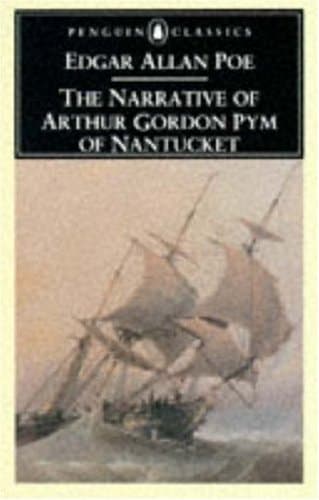
The Narrative of Arthur Gordon Pym of Nantucket
Edgar Allan PoePublished1986
Pages539
Formatpaperback
PublisherPenguin Books
Synopsis
From the book:UPON my return to the United States a few months ago, after the extraordinary series of adventure in the South Seas and elsewhere, of which an account is given in the following pages, accident threw me into the society of several gentlemen in Richmond, Va., who felt deep interest in all matters relating to the regions I had visited, and who were constantly urging it upon me, as a duty, to give my narrative to the public. I had several reasons, however, for declining to do so, some of which were of a nature altogether private, and concern no person but myself, others not so much so. One consideration which deterred me was, that, having kept no journal during a greater portion of the time in which I was absent, I feared I should not be able to write, from mere memory, a statement so minute and connected as to have the appearance of that truth it would really possess, barring only the natural and unavoidable exaggeration to which all of us are prone when detailing events which have had powerful influence in exciting the imaginative faculties. Another reason was, that the incidents to be narrated were of a nature so positively marvellous, that, unsupported as my assertions must necessarily be (except by the evidence of a single individual, and he a half–breed Indian), I could only hope for belief among my family, and those of my friends who have had reason, through life, to put faith in my veracity– the probability being that the public at large would regard what I should put forth as merely an impudent and ingenious fiction. A distrust in my own abilities as a writer was, never- theless, one of the principal causes which prevented me from complying with the suggestion of my advisers.
Recommendations
Herman Melville, Moby-Dick
by Richard Beynon
Like Pym, this is a first-person maritime narrative that blurs the line between factual account and obsessive fever dream—Ishmael's telling of the Pequod's voyage has that same quality of a man trying to convince us of something almost too extraordinary to believe. Both narrators are haunted by their experiences at sea and wrestling with how to make the reader trust their version of events that seem to defy rational explanation.
View book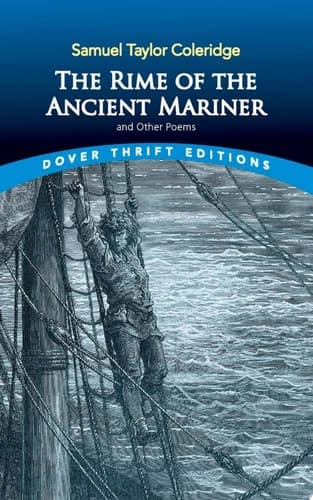
The Rime of the Ancient Mariner and Other Poems
by Samuel Taylor Coleridge
This is my surprise pick for you—it's a poem, not a novel, but it's the closest literary cousin to Pym's structure and obsession. Like Pym, the Mariner is compelled to tell his tale of supernatural horror and isolation in the frozen South, and the poem captures that same quality of a man desperate to unburden himself of an experience no one quite believes. The repetition, the atmosphere, the sense that something fundamentally wrong happened—it's all there.
View book
A Journey to the Center of the Earth
by Jules Verne
Verne takes Poe's template of an impossible voyage into unmapped territory and treats it with scientific rigor rather than gothic dread, but he maintains that same sense of wonder and terror at discovering a world that shouldn't exist. Where Pym's narrative grows increasingly hallucinatory and unreliable, Verne's Professor Lidenbrock documents everything methodically—yet both books ask us to believe in the impossible through the sheer conviction of their narrators.
View book
Joseph Conrad Heart of Darkness
by Tredell
Conrad's novella shares Pym's structure of a journey into increasingly hostile and mysterious territory, where the narrator's grip on reality becomes questionable and the landscape itself seems to possess a malevolent consciousness. Both works use the framing device of a man telling his story to listeners who may or may not believe him, and both suggest that some experiences fundamentally alter the narrator's ability to communicate what they've witnessed.
View book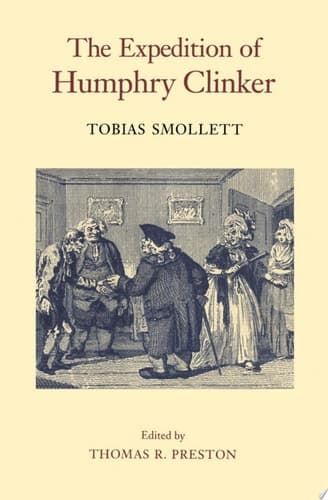
The Expedition of Humphry Clinker
by Tobias Smollett
Here's a curveball from the 18th century: Smollett writes picaresque adventure through multiple narrators' letters, creating a fractured, contradictory account of the same events—which gives you that same unreliability and question of truth that haunts Pym, but filtered through comedy and social satire rather than gothic horror. If you're curious about how earlier writers played with narrative perspective and the impossibility of objective truth, this is where some of those games began.
View bookAbout Edgar Allan Poe
E
Edgar Allan Poe
1809–1849
Edgar Allan Poe was an American writer, poet, editor and literary critic, considered part of the American Romantic Movement. Best known for his tales of mystery and the macabre, Poe was one of the earliest American practitioners of the short story and is considered the inventor of the detective-fiction genre. He is further credited with contributing to the emerging genre of science fiction.[1] He was the first well-known American writer to try to earn a living through writing alone, resulting in a financially difficult life and career.[2] Source and more information: https://en.wikipedia.org/wiki/Edgar_Allan_Poe
View author page