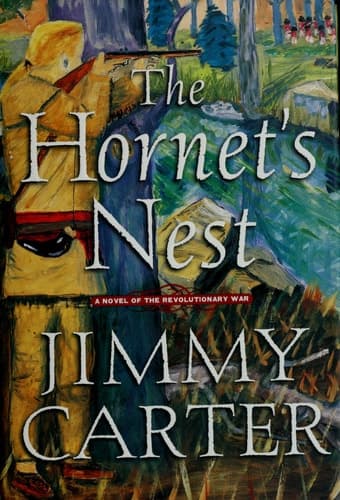
The Hornet's Nest A Novel of the Revolutionary War
Jimmy CarterPublished2004
Pages496
Formatpaperback
PublisherSimon and Schuster
Synopsis
The first work of fiction by a President of the United States—a sweeping novel of the American South and the War of Independence.
In his ambitious and deeply rewarding novel, Jimmy Carter brings to life the Revolutionary War as it was fought in the Deep South; it is a saga that will change the way we think about the conflict. He reminds us that much of the fight for independence took place in that region and that it was a struggle of both great and small battles and of terrible brutality, with neighbor turned against neighbor, the Indians’ support sought by both sides, and no quarter asked or given. The Hornet’s Nest follows a cast of characters and their loved ones on both sides of this violent conflict—including some who are based on the author’s ancestors.
At the heart of the story is Ethan Pratt, who in 1766 moves with his wife, Epsey, from Philadelphia to North Carolina and then to Georgia in 1771, in the company of Quakers. On their homesteads in Georgia, Ethan and his wife form a friendship with neighbors Kindred Morris and his wife, Mavis. Through Kindred and his young Indian friend Newota, Ethan learns about the frontier and the Native American tribes who are being continually pressed farther inland by settlers. As the eight-year war develops, Ethan and Kindred find themselves in life-and-death combat with opposing forces.
With its moving love story, vivid action, and the suspense of a war fought with increasing ferocity and stealth, The Hornet’s Nest is historical fiction at its best, in the tradition of such major classics as The Last of the Mohicans.
Recommendations
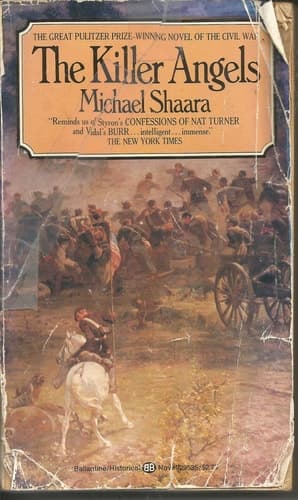
The Killer Angels
by Michael Shaara
Like Carter, Shaara gives you the Civil War through the eyes of ordinary soldiers and leaders caught in impossible choices, but he focuses on Gettysburg with an almost novelistic intensity that makes you feel the weight of each decision. Where The Hornet's Nest shows you how revolution fractures communities, Shaara shows you how war fractures the souls of men who understand exactly what they're destroying.
View book
Toni Morrison - Beloved
by Carl Plasa
This is my slight curveball for you—it's literary fiction rather than straightforward historical narrative, but Morrison uses the same Georgia landscape and the same period's aftermath to explore how violence and displacement haunt families across generations. If Carter showed you the Revolutionary War's brutality, Morrison shows you what that brutality's legacy looks like when you're not reading it as history but as lived trauma.
View book
All the Light We Cannot See A Novel
by Anthony Doerr
Doerr does something similar to what Carter accomplishes—he takes a major war and makes it personal by following characters on opposing sides whose lives intersect in unexpected ways. The dual perspective structure (a German boy, a French girl) echoes how The Hornet's Nest shows you both the settlers' and Native Americans' stakes, and Doerr has that same gift for making you understand how ordinary people become caught in extraordinary violence.
View book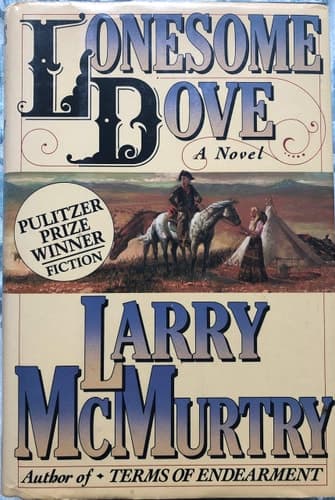
Lonesome Dove A Novel
by Larry McMurtry
McMurtry gives you an American frontier epic that's equally concerned with the small human moments as the sweeping historical canvas—two aging former Rangers, their cattle drive, the Indigenous peoples they encounter. It has that same quality where you're learning frontier history through the texture of daily life and relationships rather than through exposition, and like Carter's novel, it doesn't shy away from showing you how brutal and morally complicated westward expansion actually was.
View book
The Dovekeepers A Novel
by Alice Hoffman
Here's a different historical period entirely (ancient Masada, 70 CE), but Hoffman uses the same technique Carter does—she grounds a siege and war through the perspectives of people trying to survive it, particularly women whose stories history often overlooks. The way she weaves together multiple timelines and personal histories to show how one catastrophic event reshapes lives reminds me of how The Hornet's Nest traces the Revolutionary War's impact on individual families and friendships.
View bookAbout Jimmy Carter
J
Jimmy Carter
1924–2024
James Earl Carter Jr. (October 1, 1924 – December 29, 2024) was an American politician and humanitarian who served as the 39th president of the United States from 1977 to 1981, and also a Nobel Peace Prize laureate in 2002 for his yearlong efforts for peace and human rights.
View author page