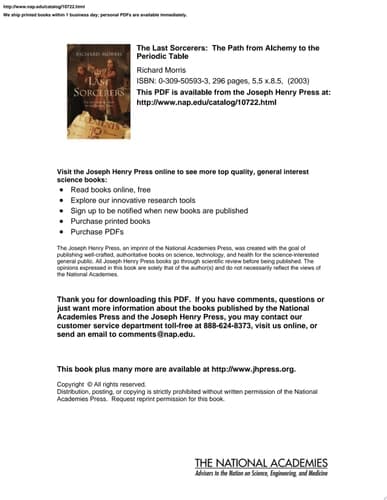
The Last Sorcerers The Path from Alchemy to the Periodic Table
Richard MorrisPublished2003
Pages294
Formatpaperback
PublisherJoseph Henry Press
Synopsis
They started with four: earth, air, fire, and water. From these basics, they sought to understand the essential ingredients of the world. Those who could see further, those who understood that the four were just the beginning, were the last sorcerers â€" and the world's first chemists.
What we now call chemistry began in the fiery cauldrons of mystics and sorcerers seeking not to make a better world through science, but rather to make themselves richer through magic formulas and con games. But among these early magicians, frauds, and con artists were a few far-seeing "alchemists" who, through rigorous experimentation, transformed mysticism into science.
By the 18th century the building blocks of nature, the elements of which all matter is composed, were on the verge of being discovery. Initially, it was not easy to determine whether a substance really was an element. Was water just water, plain and simple? Or could it be the sum of other (unknown and maybe unknowable) parts? And if water was made up of other substances, how could it be broken down into discreet, fundamental, and measurable components?
Scientific historians generally credit the great 18th century French chemist Antoine Lavoisier with addressing these fundamental questions and ultimately modernizing the field of chemistry. Through his meticulous and precise work this chaotic new field of scientific inquiry was given order. Exacting by nature, Lavoisier painstakingly set about performing experiments that would provide lasting and verifiable proofs of various chemical theories. Unfortunately, the outspoken Lavoisier eventually lost his head in the Terror, but others would follow his lead, carefully examining, measuring, and recording their findings.
As the field slowly progressed, another pioneer was to emerged almost 100 years later. Dimitri Mendeleev, an eccentric genius who cut his flowing hair and beard but once a year, sought to answer the most pressing questions that remained to chemists: Why did some elements have properties that resembled those of others? Were there certain natural groups of elements? And, if so, how many, and what elements fit into them? It was Mendeleev who finally addressed all these issues when he constructed the first Periodic Table in the late 1800s.
But between and after Lavoisier and Mendeleev were a host of other colorful, brilliant scientists who made their mark on the field of chemistry. Depicting the lively careers of these scientists and their contributions while carefully deconstructing the history and the science, author Richard Morris skillfully brings it all to life. Hailed by Kirkus Reviews as a "clear and lively writer with a penchant for down-to-earth examples" Morris's gift for explanation â€" and pure entertainment â€" is abundantly obvious. Taking a cue from the great chemists themselves, Morris has brewed up a potent combination of the alluringly obscure and the historically momentous, spiked with just the right dose of quirky and ribald detail to deliver a magical brew of history, science, and personalities.
Recommendations
Simians, Cyborgs, and Women The Reinvention of Nature
by Donna Jeanne Haraway
Like Morris, Wulf traces how a single visionary scientist fundamentally reorganized how we understand the natural world—but instead of elements, Humboldt connected ecology, geography, and climate into an integrated system. You'll get that same pleasure of watching a brilliant mind impose order on chaos, plus Wulf has the same gift for making the scientist's personality as compelling as their discoveries.
View book
Disappearing and Reviving Sándor Ferenczi in the History of Psychoanalysis
by André Haynal
This is the natural next step after Morris—Kean takes the periodic table itself and tells the wild, often bizarre human stories behind each element's discovery. Where Morris gave you the grand narrative of chemistry's birth, Kean zooms in on the eccentric characters and unexpected connections, treating the periodic table like a cabinet of curiosities rather than a textbook.
View book
The New Additive Code Breaker Everything You Should Know about Additives in Your Food
by Maurice Hanssen
Isaacson does for modern molecular biology what Morris did for classical chemistry—he shows how a transformative scientific tool (CRISPR) emerged from decades of painstaking work by brilliant, often overlooked researchers. You'll recognize that same arc of mystification-to-clarity, but updated for contemporary science where the stakes feel more immediate and the personalities are still living.
View book
Bar and Cocktail Book A Complete Guide to the World's Drinks and how to Mix and Serve Them
by Jackson Michael
Here's your surprise pick: Greenblatt traces how a single rediscovered Roman manuscript in the 15th century rippled outward to reshape European thought, eventually enabling the scientific revolution that produced chemistry itself. It's intellectual history rather than science history, but it has that same detective-work quality—following ideas backward through time to find their origins—and it'll deepen your appreciation for how alchemy and early chemistry fit into the larger story of Western thought.
View book
After the Clockwork Universe The Emerging Science and Culture of Integral Society
by Sally J. Goerner
Dolnick captures that same era of scientific ferment that produced Lavoisier, but focuses on Newton and the generation just before chemistry crystallized as a discipline. You'll see how the experimental method and mathematical rigor that transformed alchemy into chemistry were part of a broader intellectual revolution, with the same cast of brilliant, quarrelsome, sometimes fraudulent characters Morris introduced you to.
View bookAbout Richard Morris
R
Richard Morris
Born 1953
Biography coming soon.
View author page