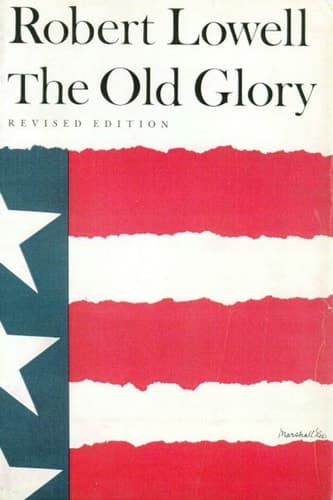
The Old Glory Endecott and the Red Cross; My Kinsman, Major Molineux; and Benito Cereno
Robert LowellPublished2000
Pages208
Formatpaperback
PublisherFarrar, Straus and Giroux
Synopsis
Winner of Five Obies, now back in print after fifteen years, a stage adaptation of classic stories by Hawthorne and Melville
In the three plays in The Old Glory--Endecott and the Red Cross; My Kinsman, Major Molineux; and Benito Cereno--the most powerful figure in postwar American poetry confronts the most haunting American fiction writers of the nineteenth century. The result is a mythical, nightmare history of three centuries in America. In Endecott and the Red Cross, Hawthorne's Puritan governor, horrified by his colony's high living, declares, "Everything in America will be Bible, blood and iron. / England will no longer exist." The other two plays, based on Hawthorne's My Kinsman, Major Molineux and Melville's Benito Cereno, take up the themes of parricide and independence: one in Boston on the eve of the Revolutionary War, the other on a merchant ship in the Caribbean in the early nineteenth century.
The plays were first performed in 1964, when the poet Randall Jarrell wrote: "I have never seen a better American play than Benito Cereno, the major play in Robert Lowell's The Old Glory . . . The play is a masterpiece of imaginative knowledge."
Recommendations
The Confidence-Man His Masquerade
by Herman Melville
Since you've clearly connected with Melville's moral ambiguity in *Benito Cereno*, this earlier novella offers a different kind of nightmare—one set on a Mississippi riverboat where every passenger might be a con artist or victim, and the reader can never quite trust what's happening. Lowell's adaptation showed how powerfully Melville captures American hypocrisy; this work is Melville at his most deliberately disorienting about who deserves our sympathy.
View book
The Crucible, Arthur Miller Notes
by David Langston
Miller wrote this play in 1953 as a direct response to McCarthyism, much as Lowell adapted these stories in 1964 to speak to his own moment—both playwrights understood that historical drama is always about the present. The Salem witch trials become a stage for examining how communities turn on themselves, with the same kind of psychological intensity and moral reckoning you found in *My Kinsman, Major Molineux*.
View book
Ralph Ellison - Invisible Man
by Anke Balduf
This 1952 novel does something Lowell's adaptations hint at but don't fully explore: it places an African American consciousness at the center of American mythmaking. The unnamed narrator's journey through various American institutions mirrors the power dynamics in *Benito Cereno*, but from a perspective that forces you to reconsider everything about visibility, identity, and who gets to tell America's story.
View book
The Apocalyptic Vision of Mikhail Bulgakov's the Master and Margarita (Studies in Slavic Language & Literature)
by Edward E. Ericson
Here's the surprise: this 1960s Russian novel shares Lowell's gift for layering multiple time periods and moral registers into a single narrative nightmare. A Soviet bureaucrat, a devil, and a writer in Stalin's Moscow create the same kind of hallucinatory, mythic quality you experienced in *The Old Glory*—but filtered through a completely different political system, which makes the parallels about power and corruption even more unsettling.
View book
In the Shadows of Divine Perfection Derek Walcott's Omeros
by Lance Callahan
Walcott's 1990 epic poem does what Lowell attempted: it rewrites classical and American narratives to center the voices and experiences that those narratives had erased. Set in the Caribbean (echoing *Benito Cereno*'s geography), it's written in a language that's simultaneously Homeric and deeply local, making it feel like a conversation between centuries about who gets to be heroic in America's story.
View bookAbout Robert Lowell
R
Robert Lowell
1917–1977
Robert Lowell was an American poet, considered the founder of the confessional poetry movement. He was appointed the sixth Poet Laureate Consultant in Poetry to the Library of Congress in 1946.[1] ([Source][1].) [1]:http://en.wikipedia.org/wiki/Robert_Lowell
View author page