
Synopsis
Extending the definition of ecology to encompass social relations and human subjectivity as well as environmental concerns, The Three Ecologies argues that the ecological crises that threaten our planet are the direct result of the expansion of a new form of capitalism and that a new ecosophical approach must be found which respects the differences between all living systems.This edition includes a chronology of Guattari's life and work, introductions to both his general philosophy and to the work itself, and extended notes to the original text.
Recommendations
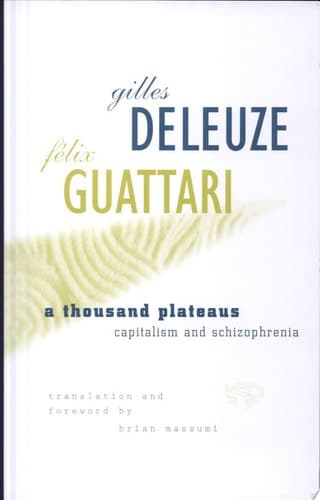
A Thousand Plateaus Capitalism and Schizophrenia
by Gilles Deleuze
Since you've engaged with Guattari's ecosophical thinking in The Three Ecologies, this co-authored work takes those concepts further into territory that's deliberately non-linear and rhizomatic—you won't read it straight through, and that's entirely the point. It's the philosophical architecture underlying the ecological framework you just encountered, presented as a kind of conceptual map rather than argument.
View book
The Savage Detectives A Novel
by Roberto Bolaño
This might seem like a departure into literary fiction, but Bolaño constructs his novel the way Guattari constructs ecosystems—as interconnected nodes where meaning emerges from relationships rather than hierarchy. The book's structure mirrors its content about searching for meaning in fragmented, late-capitalist reality, making form and philosophy inseparable in ways that will feel familiar after The Three Ecologies.
View book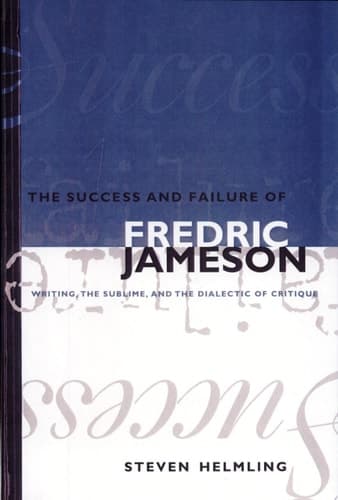
The Success and Failure of Fredric Jameson Writing, the Sublime, and the Dialectic of Critique
by Steven Helmling
Published in 1944, this earlier Frankfurt School text provides the genealogy of the capitalist logic Guattari diagnoses—it's the historical foundation explaining how we arrived at the ecological and subjective crises he describes. Reading it after Guattari gives you the origin story of the problem he's proposing ecosophical solutions for.
View book
Friendship Bands Braiding, Weaving, Knotting
by Marlies Busch
Here's your surprise pick: Kimmerer approaches the same ecological and relational thinking as Guattari, but through Indigenous knowledge systems and botanical observation rather than poststructuralist theory. Where Guattari is abstract and systemic, Kimmerer is grounded and sensory—yet both argue that respecting difference in living systems requires fundamentally reimagining our relationship to nature and each other.
View book
Comments on the Society of the Spectacle
by Guy Debord
Debord's analysis of how capitalism colonizes experience and representation provides another angle on the subjective ecology Guattari explores—he's diagnosing how late capitalism doesn't just damage ecosystems but manufactures false consciousness and alienation. Together, these two thinkers give you a complete picture of how capitalism operates across environmental, social, and psychological registers.
View bookAbout Félix Guattari
F
Félix Guattari
1930–1992
Pierre-Félix Guattari (April 30, 1930 – August 29, 1992) was a French psychotherapist, philosopher, semiologist, and activist. He founded both schizoanalysis and ecosophy, and is best known for his intellectual collaborations with Gilles Deleuze, most notably *Anti-Oedipus* (1972) and *A Thousand Plateaus* (1980), the two volumes of *Capitalism and Schizophrenia*. **Source**: <a href="https://en.wikipedia.org/wiki/F%C3%A9lix_Guattari">Felix Guattari</a> on Wikipedia (<a href="https://en.wikipedia.org/wiki/Wikipedia:Text_of_Creative_Commons_Attribution-ShareAlike_3.0_Unported_License">CC BY-SA 3.0</a>).
View author page