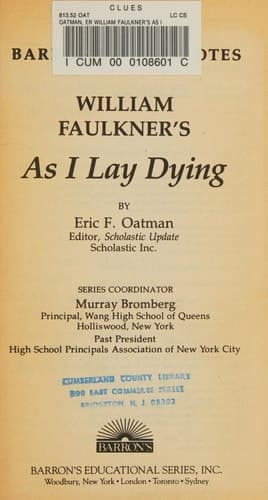
William Faulkner's As I Lay Dying
Eric F. OatmanPublished1985
Pages122
Formatpaperback
PublisherBarron's Educational Series
Synopsis
A guide to reading "As I Lay Dying" with a critical and appreciative mind encouraging analysis of plot, style, form, and structure. Also includes background on the author's life and times, sample tests, term paper suggestions, and a reading list.
Recommendations

William Faulkner The Sound and the Fury ; As I Lay Dying
by Nicolas Tredell
Since you've just worked through a study guide on Faulkner's fragmented narrative technique, you're now perfectly positioned to tackle his even more demanding masterpiece. Where *As I Lay Dying* uses multiple perspectives across a journey, *The Sound and the Fury* fractures time itself—the opening section is narrated by a man with an intellectual disability, and Faulkner refuses to make it easy for you. You've already trained your eye for his stream-of-consciousness style; this will deepen that skill considerably.
View book
Toni Morrison - Beloved
by Carl Plasa
Morrison does something similar to what you've just studied in Faulkner—she uses non-linear storytelling and multiple narrative voices to explore trauma and family bonds—but she's working with entirely different material and cultural memory. The way she layers past and present, the way a ghost becomes as real as any living character, shows you how modernist techniques can serve stories about the American experience that Faulkner's work largely ignored.
View book
Ficciones
by Jorge Luis Borges
Here's your surprise pick: these short stories are nothing like the sprawling Faulkner narrative you just finished, yet they're obsessed with similar questions about how stories work and how we construct meaning. Borges plays with form in ways that feel almost like literary puzzles—stories about infinite libraries, forking paths in time, maps that are larger than the territory they describe. If you enjoyed analyzing Faulkner's *structure*, you'll find Borges is doing something equally radical but in miniature.
View book
Gabriel García Márquez: One Hundred Years of Solitude
by Michael Wood
Márquez takes the multi-generational family saga structure that Faulkner pioneered and transplants it to a magical-realist setting where the impossible becomes mundane. Like *As I Lay Dying*, it's a book about how families repeat themselves, how the past haunts the present—but Márquez adds cyclical time and magical elements that make the repetition feel almost inevitable, almost mythic. The style is more lyrical than Faulkner's, but the structural ambition is comparable.
View bookAbout Eric F. Oatman
Biography coming soon.
View author page