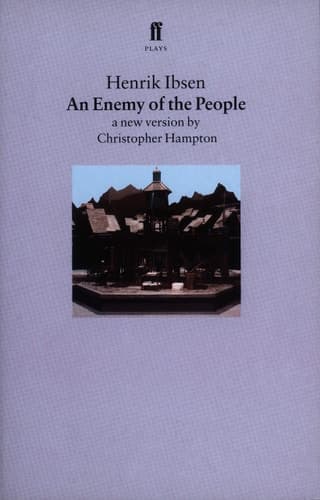
An Enemy of the People A New Version by Christopher Hampton
Henrik IbsenPublished1997
Pages130
Formatpaperback
PublisherMacmillan
Synopsis
An Enemy of the People concerns the actions of Doctor Thomas Stockmann, a medical officer charged with inspecting the public baths on which the prosperity of his native town depends. He finds the water to be contaminated. When he refuses to be silenced, he is declared an enemy of the people. Stockmann served as a spokesman for Ibsen, who felt that his plays gave a true, if not always palatable, picture of life and that truth was more important than critical approbation.
Recommendations
The Crucible, Arthur Miller Notes
by David Langston
Miller's Salem witch trials drama operates on the same principle as Stockmann's dilemma—a protagonist watching hysteria override reason, and the terrifying machinery of public opinion crushing individual conscience. Both plays feel urgently contemporary precisely because they're about how communities turn on truth-tellers, and Miller captures that same suffocating inevitability as the town closes ranks.
View book
The remains of the day de Kazuo Ishiguro
by Gallix/François
Where Stockmann refuses to compromise his integrity, Ishiguro's butler Stevens has spent a lifetime compromising his—and the novel's quiet devastation comes from watching him rationalize away his own judgment in service to authority. It's a companion piece to Ibsen's play: what happens when someone chooses loyalty to institutions over truth, and how that choice haunts them.
View book
The New Utopian Politics of Ursula K. Le Guin's The Dispossessed
by Laurence Davis
This is the surprise one, but hear me out: Le Guin uses science fiction to do exactly what Ibsen does with realism—she strips away comfortable assumptions about how society should work and forces both her protagonist and reader to confront inconvenient truths. A physicist moving between two worlds becomes an uncomfortable voice questioning the status quo, and Le Guin explores the cost of that honesty with the same unflinching eye Ibsen brings to small-town politics.
View book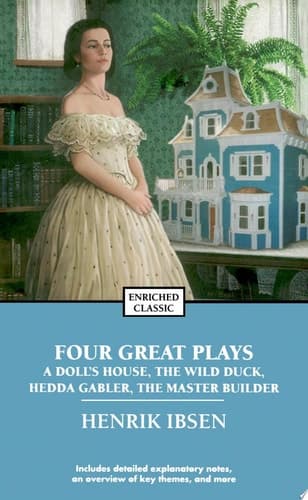
Four Great Plays of Henrik Ibsen A Doll's House, The Wild Duck, Hedda Gabler, The Master Builder
by Henrick Ibsen
I know—same author, but this is genuinely different territory. Where *An Enemy of the People* is about public conscience, *A Doll's House* examines private rebellion, and Ibsen's technique here is even more radical: he builds an intimate domestic drama that explodes into philosophical confrontation. If you're drawn to Ibsen's refusal to let his characters off easy, this one goes even deeper into the personal cost of integrity.
View book
All the Light We Cannot See A Novel
by Anthony Doerr
Doerr's World War II novel captures something essential about Stockmann's position: characters caught between personal conscience and the overwhelming pressure of systems larger than themselves. A German soldier and a French girl both face moments where doing the right thing means standing against the machinery of their own societies, and Doerr renders that moral isolation with the same gravity Ibsen brings to his provincial town.
View bookAbout Henrik Ibsen
H
Henrik Ibsen
1828–1906
Henrik Ibsen was a major 19th-century Norwegian playwright, theatre director, and poet. He is often referred to as "the god father" of modern drama and is one of the founders of Modernism in the theatre.[1] His plays were considered scandalous to many of his era, when Victorian values of family life and propriety largely held sway in Europe. Ibsen's work examined the realities that lay behind many facades, possessing a revelatory nature that was disquieting to many contemporaries. It utilized a critical eye and free inquiry into the conditions of life and issues of morality. Ibsen is often ranked as one of the truly great playwrights in the European tradition, alongside Shakespeare. <cite>— [Wikipedia](https://en.wikipedia.org/wiki/Henrik_Ibsen)</cite>
View author page