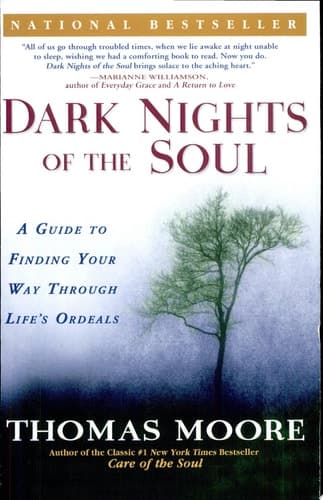
Dark Nights of the Soul A Guide to Finding Your Way Through Life's Ordeals
Thomas MoorePublished2005
Pages352
Formatpaperback
PublisherPenguin
Synopsis
Every human life is made up of the light and the dark, the happy and the sad, the vital and the deadening. How you think about this rhythm of moods makes all the difference.
Our lives are filled with emotional tunnels: the loss of a loved one or end of a relationship, aging and illness, career disappointments or just an ongoing sense of dissatisfaction with life. Society tends to view these “dark nights” in clinical terms as obstacles to be overcome as quickly as possible. But Moore shows how honoring these periods of fragility as periods of incubation and positive opportunities to delve the soul’s deepest needs can provide healing and a new understanding of life’s meaning. Dark Nights of the Soul presents these metaphoric dark nights not as the enemy, but as times of transition, occasions to restore yourself, and transforming rites of passage, revealing an uplifting and inspiring new outlook on such topics as:
• The healing power of melancholy
• The sexual dark night and the mysteries of matrimony
• Finding solace during illness and in aging
• Anxiety, anger, and temporary Insanities
• Linking creativity, spirituality, and emotional struggles
• Finding meaning and beauty in the darkness
Recommendations

The Year of Magical Thinking A Play by Joan Didion Based on Her Memoir
by Joan Didion
Where Moore philosophizes about dark nights as spiritual incubation, Didion documents her own descent into grief with unflinching precision—no metaphors, just the raw mathematics of loss. You'll find the same conviction that suffering contains its own intelligence, but filtered through Didion's crystalline prose rather than Moore's more mystical approach. It's Moore's ideas tested against the actual texture of devastation.
View book
The Denial of Death
by Ernest Becker
Becker writes like a psychologist possessed by philosophy—he takes the anxiety and existential dread Moore treats as soul-work and traces them back to our fundamental terror of mortality. If Moore shows you how to honor the dark night, Becker explains *why* we're so afraid of it in the first place. Published in 1973, it's older than Moore's work but feels urgently contemporary, and it'll deepen your understanding of what Moore means by 'fragility as incubation.'
View book
The remains of the day de Kazuo Ishiguro
by Gallix/François
This is the surprise pick: a novel rather than philosophy, but it's essentially about a man in his own dark night—one he's spent decades refusing to acknowledge. Ishiguro does what Moore only gestures toward: he shows you a character whose emotional numbness and 'deadening' (Moore's word) has calcified into his entire identity. The quiet devastation builds the way Moore describes melancholy—not as depression to cure, but as a truth demanding recognition.
View book
When Things Fall Apart Heart Advice for Difficult Times
by Pema Chödrön
Chödrön approaches the dark night from a Buddhist perspective where Moore draws on Christian and Jungian traditions—but they're remarkably aligned. She teaches that falling apart isn't failure but awakening, and her practical wisdom (meditation, specific mental reframings) gives you tools where Moore gives you permission. If Moore convinced you the darkness matters, Chödrön will show you how to actually live inside it without drowning.
View book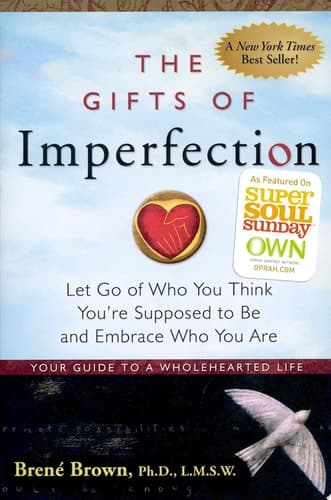
The Gifts of Imperfection Let Go of Who You Think You're Supposed to Be and Embrace Who You Are
by Breň Brown
Brown researches vulnerability the way Moore philosophizes about it—through thousands of interviews rather than archetypal analysis. Where Moore might speak of 'the soul's deepest needs,' Brown gets specific: shame, perfectionism, the fear of being seen. Her work is more practical and contemporary than Moore's, grounded in data rather than Jung, but they're asking the same question: what happens when we stop fighting our fragility and start honoring it?
View bookAbout Thomas Moore
T
Thomas Moore
Born 1946
Roméo Antonius Dallaire OC CMM GOQ MSC CD is a Canadian humanitarian, author, retired senator and Canadian Forces lieutenant-general. Dallaire served as force commander of UNAMIR, the ill-fated United Nations peacekeeping force for Rwanda between 1993 and 1994, and attempted to stop the genocide that was being waged by Hutu extremists against the Tutsi people and Hutu moderates. *-- Wikipedia* *Photo Attribution:* Michelle Campbell, CEO, St Joseph's Health Care Foundation, London Ontario, CC BY-SA 4.0 <https://creativecommons.org/licenses/by-sa/4.0>, via Wikimedia Commons
View author page