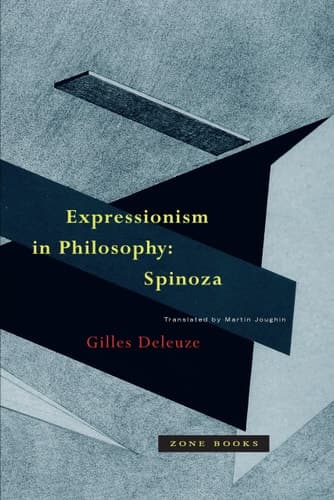
Expressionism in Philosophy Spinoza
Gilles DeleuzePublished1990
Pages445
Formatpaperback
PublisherZone Books
Synopsis
In this extraordinary work Gilles Deleuze, the most renowned living philosopher in France, reflects on one of the figures of the past who has most influenced his own sweeping reconfiguration of the tasks of philosophy. Deleuze's brilliant text shows how current definitions of philosophy do not apply to Spinoza: a solitary thinker (yet scandalous and hated), he conceived of philosophy as an enterprise of liberation and radical demystification much as did Leibniz or, later Nietzsche. Spinoza confronts the grand philosophical problems that are still current today: the comparative role of ontology (the theory of substance), of epistemology (the theory of ideas), and of political anthropology (the theory of modes, passions, and actions). The goal of this book is to determine the rapport among the univocity of Being in the theory of substance; the production of truth and the genesis of sense in the theory of ideas; and practical joy (or the elimination of the sad passions) and the selective organization of the passions in the theory of modes.
Recommendations
Difference and Repetition
by Gilles Deleuze
Wait—I know what you're thinking. But hear me out: if you found yourself wrestling with Deleuze's treatment of substance and univocity in the Spinoza book, this is where he develops those concepts into their full philosophical architecture. It's denser, yes, but you've already proven you can handle his density, and this will make the Spinoza text click into place like a key turning in a lock.
View book
A Commentary on Jean-Paul Sartre's Being and Nothingness
by Joseph S. Catalano
Sartre's wrestling with Being and essence offers a fascinating counterpoint to Deleuze's Spinozist univocity—where Deleuze finds liberation in the affirmative power of substance, Sartre locates it in radical freedom and negation. You'll find yourself in productive disagreement with nearly every page, which is exactly the kind of philosophical friction that deepens understanding.
View book
The Savage Detectives A Novel
by Roberto Bolaño
This might seem like a left turn, but Bolaño's novel operates with the same philosophical intensity you just experienced—it's structured around competing systems of meaning (poetry movements, detective narratives, historical fragments) that refuse to cohere into a single truth. The book enacts philosophically what Deleuze theorizes: multiplicity without hierarchy, sense-making without final answers.
View book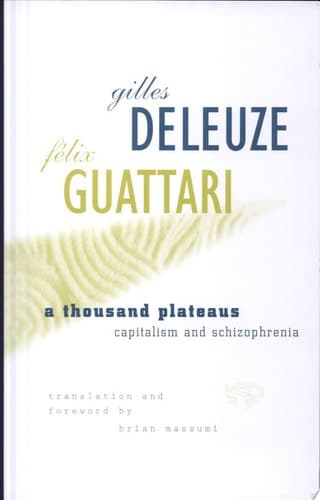
A Thousand Plateaus Capitalism and Schizophrenia
by Gilles Deleuze
Co-written by Deleuze's longtime collaborator, this work takes the Spinozist insights about modes, passions, and practical joy into applied territories—desire, politics, becoming. Where Expressionism in Philosophy is Deleuze in scholarly mode, this book is Deleuze and Guattari unleashed, using Spinoza's framework to think through everything from music to war machines.
View book
Hegel's Preface to the Phenomenology of Spirit
by Georg Wilhelm Friedrich Hegel
Published nearly two centuries before your Deleuze, Hegel's masterwork is the philosophical ancestor that Deleuze is implicitly arguing against—Hegel's dialectical method versus Deleuze's affirmative univocity. Reading them in this order (Deleuze first) actually gives you the advantage: you'll see exactly where and why Deleuze breaks with the Hegelian tradition, rather than getting lost in Hegel's own labyrinth.
View bookAbout Gilles Deleuze
Biography coming soon.
View author page