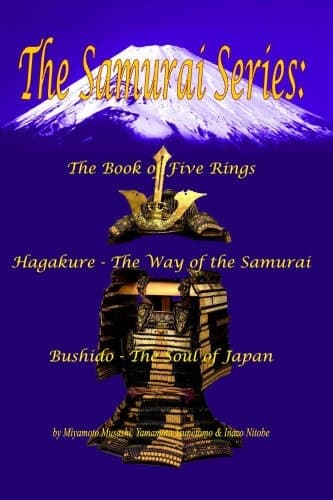
The Samurai Series The Book of Five Rings, Hagakure -The Way of the Samurai & Bushido - The Soul of Japan
Musashi MiyamotoPublished2006
Pages256
Formatpaperback
PublisherEl Paso Norte Press
Synopsis
The Samurai Series brings together three of the most important books that deal with the Samurai path and philosophy into one volume. It contains:
The Book of Five Rings which was written by Miyamoto Musashi, a Samurai of legendary renown, about 1645 AD. It is a masterpiece of simple exposition written by a master swordsman, who, near the end of his spectacular life, tried earnestly to explain the essentials of individual combat and the essence of being a Samurai. His book is widely considered to a cornerstone of the philosophy of Bushido.
Hagakure - The Way of the Samurai, which means: Hidden by Leaves, that was composed from dialogs by the famous Samurai, Yamamoto Tsunetomo, by a scribe, Tashiro Tsuramoto, about 1716 AD. It explains the major ideas and philosophy that are essential to the way of the Samurai, by which is meant the way of dying. It contains numerous tales of various Samurai and their deeds which illustrate their philosophy and practice.
Bushido - The Soul of Japan by Inazo Nitobe which was first published 1899. It is an extremely literate presentation by a Japanese intellectual who wished to present Japan and its fundamental philosophy in a way that could be understood by Westerners. It describes how the Shinto religion and Buddhism are the underpinnings of the essentially militaristic view of honor and life that are inherent in Bushido, the Samurai code.
Excerpt from The Book of Five Rings. Reprinted by permission. All rights reserved.
The Gaze in Strategy
The gaze should be large and broad. This is the twofold gaze, Perception and Sight. Perception is strong and sight, weak.
In strategy, it is important to see distant things as if they were close, and to take a distanced view of close things. It is important in strategy to know the enemy's sword, yet not be distracted by insignificant movements of his sword. You must study this. The gaze is the same for single combat and for large-scale strategy.
It is necessary in strategy to be able to look to both sides without moving the eyeballs. You cannot master this ability quickly. Learn what is written here; use this gaze in everyday life and do not vary it...
Recommendations
The Art of War by Sun Tzu and the Book of Five Rings by Miyamoto Musashi
by Sun Tzu
You've just absorbed Musashi's meditation on individual combat and perception—Sun Tzu offers the complementary view from centuries earlier, applying those same principles of strategy, positioning, and psychological awareness to large-scale warfare. Where Musashi emphasizes the internal discipline of the swordsman, Sun Tzu is obsessed with terrain, timing, and knowing your opponent before the battle begins. They're like two philosophers staring at the same problem from opposite ends of a telescope.
View book
Zen and the Art of Motorcycle Maintenance An Inquiry Into Values
by Robert M. Pirsig
This 1974 book does something unexpected—it takes the meditative, quality-obsessed mindset you've been reading about in Bushido and applies it to American motorcycle repair and a cross-country journey. Pirsig wrestles with the same tension between technique and spirit, between doing things "right" and understanding *why* they matter, that runs through all three samurai texts. It's philosophy dressed up as a road trip, but the rigor is genuine.
View book
Hagakure The Book of the Samurai
by Tsunetomo Yamamoto
I know you've read Hagakure already in that collection, but Cleary's standalone translation (published 1999) includes extensive historical commentary and contextual essays that illuminate *why* Yamamoto Tsunetomo wrote what he did and how his ideas were received. It's like getting a second reading with a knowledgeable guide pointing out the architecture you missed the first time—particularly useful for understanding the tension between the idealized samurai code and the actual political chaos of his era.
View book
Letters to a Young Poet
by Rainer Maria Rilke
This slim collection of letters (1903-1908) reads like Musashi's *Book of Five Rings* rewritten for an artist instead of a swordsman—Rilke advises a young writer on patience, on sitting with questions rather than rushing to answers, on the discipline required to do meaningful work. The spiritual rigor and the insistence that mastery requires both technical precision and deep introspection will feel immediately familiar, just applied to creative rather than martial practice.
View bookAbout Musashi Miyamoto
M
Musashi Miyamoto
1584–1645
Biography coming soon.
View author page