“A room without books is like a body without a soul.”
59 likes
Author detail
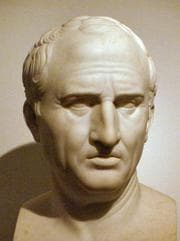
**Marcus Tullius Cicero** (pronounced /ˈsɪsɨroʊ/; Classical Latin: [ˈkikeroː]; January 3, 106 BC – December 7, 43 BC) was a Roman philosopher, statesman, lawyer, political theorist, and Roman constitutionalist. He came from a wealthy municipal family of the equestrian order, and is widely considered one of Rome's greatest orators and prose stylists. He introduced the Romans to the chief schools of Greek philosophy and created a Latin philosophical vocabulary (with neologisms such as humanitas, qualitas, quantitas, and essentia) distinguishing himself as a linguist, translator, and philosopher. An impressive orator and successful lawyer, Cicero thought that his political career was his most important achievement. Today, he is appreciated primarily for his humanism and philosophical and political writings. His voluminous correspondence, much of it addressed to his friend Atticus, has been especially influential, introducing the art of refined letter writing to European culture. Cornelius Nepos, the 1st-century BC biographer of Atticus, remarked that Cicero's letters contained such a wealth of detail "concerning the inclinations of leading men, the faults of the generals, and the revolutions in the government" that their reader had little need for a history of the period. Cicero's speeches and letters remain some of the most important primary sources that survive on the last days of the Roman Republic. During the chaotic latter half of the first century B.C. marked by civil wars and the dictatorship of Gaius Julius Caesar, Cicero championed a return to the traditional republican government. However, his career as a statesman was marked by inconsistencies and a tendency to shift his position in response to changes in the political climate. His indecision may be attributed to his sensitive and impressionable personality; he was prone to overreaction in the face of political and private change. "Would that he had been able to endure prosperity with greater self-control and adversity with more fortitude!" wrote C. Asinius Pollio, a contemporary Roman statesman and historian. Cicero became an enemy of Mark Antony, attacking him in a series of speeches. He was proscribed an enemy of the state by the Second Triumvirate and subsequently murdered in 43 BC. Source: Wikipedia
Quotes
Showing 1-20 of 169
“A room without books is like a body without a soul.”
59 likes
“While there's life, there's hope.”
0 likes
“It is foolish to tear one’s hair in grief, as though sorrow would be made less by baldness.”
0 likes
“The life given us, by nature is short; but the memory of a well-spent life is eternal.”
0 likes
“To study philosophy is nothing but to prepare one’s self to die.”
0 likes
“Sed nescio quo modo nihil tam absurde dici potest quod non dicatur ab aliquo philosphorum. (There is nothing so absurd but some philosopher has said it.)”
0 likes
“What is morally wrong can never be advantageous, even when it enables you to make some gain that you believe to be to your advantage. The mere act of believing that some wrongful course of a...”
0 likes
“I criticize by creation, not by finding fault.”
0 likes
“We must not only obtain Wisdom: we must enjoy her.”
0 likes
“Time obliterates the fictions of opinion and confirms the decisions of nature.”
0 likes
“I have taken so kindly to idleness that I can't tear myself away from it. So either I amuse myself with books, of which I have a good stock at Antium, or I count the waves - the weather is u...”
0 likes
“Nature abhors annihilation.”
0 likes
“Advice in old age is foolish; for what can be more absurd than to increase our provisions for the road the nearer we approach to our journey's end.”
0 likes
“There is nothing so absurd that some philosopher has not already said it.”
0 likes
“The harvest of old age is the recollection and abundance of blessing previously secured.”
0 likes
“When you have no basis for an argument, abuse the plaintiff.”
0 likes
“Nothing is so unbelievable that oratory cannot make it acceptable.”
0 likes
“One who sees the Supersoul accompanying the individual soul in all bodies and who understands that neither the soul nor the Supersoul is ever destroyed, actually sees.”
0 likes
“According to the law of nature it is only fair that no one should become richer through damages and injuries suffered by another.”
0 likes
“As fire when thrown into water is cooled down and put out, so also a false accusation when brought against a man of the purest and holiest character, boils over and is at once dissipated, an...”
0 likes