“It is not by muscle, speed, or physical dexterity that great things are achieved, but by reflection, force of character, and judgment.”
0 likes
Author detail
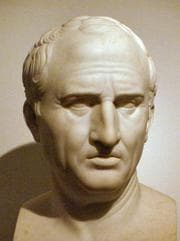
**Marcus Tullius Cicero** (pronounced /ˈsɪsɨroʊ/; Classical Latin: [ˈkikeroː]; January 3, 106 BC – December 7, 43 BC) was a Roman philosopher, statesman, lawyer, political theorist, and Roman constitutionalist. He came from a wealthy municipal family of the equestrian order, and is widely considered one of Rome's greatest orators and prose stylists. He introduced the Romans to the chief schools of Greek philosophy and created a Latin philosophical vocabulary (with neologisms such as humanitas, qualitas, quantitas, and essentia) distinguishing himself as a linguist, translator, and philosopher. An impressive orator and successful lawyer, Cicero thought that his political career was his most important achievement. Today, he is appreciated primarily for his humanism and philosophical and political writings. His voluminous correspondence, much of it addressed to his friend Atticus, has been especially influential, introducing the art of refined letter writing to European culture. Cornelius Nepos, the 1st-century BC biographer of Atticus, remarked that Cicero's letters contained such a wealth of detail "concerning the inclinations of leading men, the faults of the generals, and the revolutions in the government" that their reader had little need for a history of the period. Cicero's speeches and letters remain some of the most important primary sources that survive on the last days of the Roman Republic. During the chaotic latter half of the first century B.C. marked by civil wars and the dictatorship of Gaius Julius Caesar, Cicero championed a return to the traditional republican government. However, his career as a statesman was marked by inconsistencies and a tendency to shift his position in response to changes in the political climate. His indecision may be attributed to his sensitive and impressionable personality; he was prone to overreaction in the face of political and private change. "Would that he had been able to endure prosperity with greater self-control and adversity with more fortitude!" wrote C. Asinius Pollio, a contemporary Roman statesman and historian. Cicero became an enemy of Mark Antony, attacking him in a series of speeches. He was proscribed an enemy of the state by the Second Triumvirate and subsequently murdered in 43 BC. Source: Wikipedia
Quotes
Showing 21-40 of 169
“It is not by muscle, speed, or physical dexterity that great things are achieved, but by reflection, force of character, and judgment.”
0 likes
“Frivolity is inborn, conceit acquired by education.”
0 likes
“We should not be so taken up in the search for truth, as to neglect the needful duties of active life; for it is only action that gives a true value and commendation to virtue.”
0 likes
“I add this, that rational ability without education has oftener raised man to glory and virtue, than education without natural ability.”
0 likes
“Great is our admiration of the orator who speaks with fluency and discretion.”
0 likes
“I never admire another's fortune so much that I became dissatisfied with my own.”
0 likes
“Though silence is not necessarily an admission, it is not a denial, either.”
0 likes
“Live as brave men; and if fortune is adverse, front its blows with brave hearts.”
0 likes
“No one can give you better advice than yourself.”
0 likes
“Nobody can give you wiser advice than yourself.”
0 likes
“As I approve of a youth that has something of the old man in him, so I am no less pleased with an old man that has something of the youth. He that follows this rule may be old in body, but c...”
0 likes
“Let us not listen to those who think we ought to be angry with our enemies, and who believe this to be great and manly. Nothing is so praiseworthy, nothing so clearly shows a great and noble...”
0 likes
“What an ugly beast the ape, and how like us.”
0 likes
“Silence is one of the great arts of conversation.”
0 likes
“If we are not ashamed to think it, we should not be ashamed to say it.”
0 likes
“I am not ashamed to confess that I am ignorant of what I do not know.”
0 likes
“When you are aspiring to the highest place, it is honorable to reach the second or even the third rank.”
0 likes
“Like associates with like.”
0 likes
“Natural ability without education has more often attained to glory and virtue than education without natural ability.”
0 likes
“Love is the attempt to form a friendship inspired by beauty.”
0 likes