“It is foolish to tear one's hair in grief, as though sorrow would be made less by baldness.”
0 likes
Author detail
**Marcus Tullius Cicero** (pronounced /ˈsɪsɨroʊ/; Classical Latin: [ˈkikeroː]; January 3, 106 BC – December 7, 43 BC) was a Roman philosopher, statesman, lawyer, political theorist, and Roman constitutionalist. He came from a wealthy municipal family of the equestrian order, and is widely considered one of Rome's greatest orators and prose stylists. He introduced the Romans to the chief schools of Greek philosophy and created a Latin philosophical vocabulary (with neologisms such as humanitas, qualitas, quantitas, and essentia) distinguishing himself as a linguist, translator, and philosopher. An impressive orator and successful lawyer, Cicero thought that his political career was his most important achievement. Today, he is appreciated primarily for his humanism and philosophical and political writings. His voluminous correspondence, much of it addressed to his friend Atticus, has been especially influential, introducing the art of refined letter writing to European culture. Cornelius Nepos, the 1st-century BC biographer of Atticus, remarked that Cicero's letters contained such a wealth of detail "concerning the inclinations of leading men, the faults of the generals, and the revolutions in the government" that their reader had little need for a history of the period. Cicero's speeches and letters remain some of the most important primary sources that survive on the last days of the Roman Republic. During the chaotic latter half of the first century B.C. marked by civil wars and the dictatorship of Gaius Julius Caesar, Cicero championed a return to the traditional republican government. However, his career as a statesman was marked by inconsistencies and a tendency to shift his position in response to changes in the political climate. His indecision may be attributed to his sensitive and impressionable personality; he was prone to overreaction in the face of political and private change. "Would that he had been able to endure prosperity with greater self-control and adversity with more fortitude!" wrote C. Asinius Pollio, a contemporary Roman statesman and historian. Cicero became an enemy of Mark Antony, attacking him in a series of speeches. He was proscribed an enemy of the state by the Second Triumvirate and subsequently murdered in 43 BC. Source: Wikipedia
Quotes
Showing 41-60 of 169
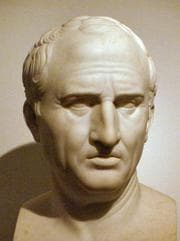
“It is foolish to tear one's hair in grief, as though sorrow would be made less by baldness.”
0 likes
“Just as the soul fills the body, so God fills the world. Just as the soul bears the body, so God endures the world. Just as the soul sees but is not seen, so God sees but is not seen. Just a...”
0 likes
“Rashness belongs to youth; prudence to old age.”
0 likes
“The rule of friendship means there should be mutual sympathy between them, each supplying what the other lacks and trying to benefit the other, always using friendly and sincere words.”
0 likes
“What gift has providence bestowed on man that is so dear to him as his children?”
0 likes
“No obligation to do the impossible is binding.”
0 likes
“A letter does not blush.”
0 likes
“A home without books is a body without soul.”
0 likes
“To be ignorant of what occurred before you were born is to remain always a child.”
0 likes
“Brevity is a great charm of eloquence.”
0 likes
“Brevity is the best recommendation of speech, whether in a senator or an orator.”
0 likes
“All pain is either severe or slight, if slight, it is easily endured; if severe, it will without doubt be brief.”
0 likes
“The wise are instructed by reason, average minds by experience, the stupid by necessity and the brute by instinct.”
0 likes
“I never heard of an old man forgetting where he had buried his money! Old people remember what interests them: the dates fixed for their lawsuits, and the names of their debtors and creditor...”
0 likes
“The pursuit, even of the best things, ought to be calm and tranquil.”
0 likes
“Before beginning, plan carefully.”
0 likes
“In doubtful cases the more liberal interpretation must always be preferred.”
0 likes
“Orators are most vehement when their cause is weak.”
0 likes
“Take from a man his reputation for probity, and the more shrewd and clever he is, the more hated and mistrusted he becomes.”
0 likes
“In everything, satiety closely follows the greatest pleasures.”
0 likes