“We must conceive of this whole universe as one commonwealth of which both gods and men are members.”
0 likes
Author detail
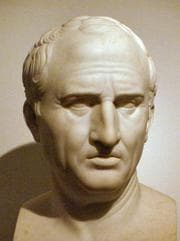
**Marcus Tullius Cicero** (pronounced /ˈsɪsɨroʊ/; Classical Latin: [ˈkikeroː]; January 3, 106 BC – December 7, 43 BC) was a Roman philosopher, statesman, lawyer, political theorist, and Roman constitutionalist. He came from a wealthy municipal family of the equestrian order, and is widely considered one of Rome's greatest orators and prose stylists. He introduced the Romans to the chief schools of Greek philosophy and created a Latin philosophical vocabulary (with neologisms such as humanitas, qualitas, quantitas, and essentia) distinguishing himself as a linguist, translator, and philosopher. An impressive orator and successful lawyer, Cicero thought that his political career was his most important achievement. Today, he is appreciated primarily for his humanism and philosophical and political writings. His voluminous correspondence, much of it addressed to his friend Atticus, has been especially influential, introducing the art of refined letter writing to European culture. Cornelius Nepos, the 1st-century BC biographer of Atticus, remarked that Cicero's letters contained such a wealth of detail "concerning the inclinations of leading men, the faults of the generals, and the revolutions in the government" that their reader had little need for a history of the period. Cicero's speeches and letters remain some of the most important primary sources that survive on the last days of the Roman Republic. During the chaotic latter half of the first century B.C. marked by civil wars and the dictatorship of Gaius Julius Caesar, Cicero championed a return to the traditional republican government. However, his career as a statesman was marked by inconsistencies and a tendency to shift his position in response to changes in the political climate. His indecision may be attributed to his sensitive and impressionable personality; he was prone to overreaction in the face of political and private change. "Would that he had been able to endure prosperity with greater self-control and adversity with more fortitude!" wrote C. Asinius Pollio, a contemporary Roman statesman and historian. Cicero became an enemy of Mark Antony, attacking him in a series of speeches. He was proscribed an enemy of the state by the Second Triumvirate and subsequently murdered in 43 BC. Source: Wikipedia
Quotes
Showing 61-80 of 169
“We must conceive of this whole universe as one commonwealth of which both gods and men are members.”
0 likes
“Hatreds not vowed and concealed are to be feared more than those openly declared.”
0 likes
“Rather leave the crime of the guilty unpunished than condemn the innocent.”
0 likes
“Not cohabitation but consensus constitutes marriage.”
0 likes
“Virtue is a habit of the mind, consistent with nature and moderation and reason.”
0 likes
“Nothing stands out so conspicuously, or remains so firmly fixed in the memory, as something which you have blundered.”
0 likes
“Justice is the set and constant purpose which gives every man his due.”
0 likes
“We are motivated by a keen desire for praise, and the better a man is the more he is inspired by glory. The very philosophers themselves, even in those books which they write in contempt of...”
0 likes
“The enemy is within the gates; it is with our own luxury, our own folly, our own criminality that we have to contend.”
0 likes
“In so far as the mind is stronger than the body, so are the ills contracted by the mind more severe than those contracted by the body.”
0 likes
“In everything truth surpasses the imitation and copy.”
0 likes
“The countenance is the portrait of the soul, and the eyes mark its intentions.”
0 likes
“True glory takes root, and even spreads; all false pretences, like flowers, fall to the ground; nor can any counterfeit last long.”
0 likes
“Confidence is that feeling by which the mind embarks in great and honorable courses with a sure hope and trust in itself.”
0 likes
“This is the truth: as from a fire aflame thousands of sparks come forth, even so from the Creator an infinity of beings have life and to him return again.”
0 likes
“It might be pardonable to refuse to defend some men, but to defend them negligently is nothing short of criminal.”
0 likes
“I criticize by creation - not by finding fault.”
0 likes
“Old age: the crown of life, our play's last act.”
0 likes
“Cultivation to the mind is as necessary as food to the body.”
0 likes
“Knowledge which is divorced from justice, may be called cunning rather than wisdom.”
0 likes