“The best interpreter of the law is custom.”
0 likes
Author detail
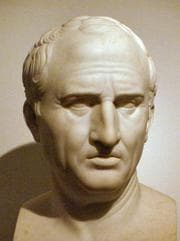
**Marcus Tullius Cicero** (pronounced /ˈsɪsɨroʊ/; Classical Latin: [ˈkikeroː]; January 3, 106 BC – December 7, 43 BC) was a Roman philosopher, statesman, lawyer, political theorist, and Roman constitutionalist. He came from a wealthy municipal family of the equestrian order, and is widely considered one of Rome's greatest orators and prose stylists. He introduced the Romans to the chief schools of Greek philosophy and created a Latin philosophical vocabulary (with neologisms such as humanitas, qualitas, quantitas, and essentia) distinguishing himself as a linguist, translator, and philosopher. An impressive orator and successful lawyer, Cicero thought that his political career was his most important achievement. Today, he is appreciated primarily for his humanism and philosophical and political writings. His voluminous correspondence, much of it addressed to his friend Atticus, has been especially influential, introducing the art of refined letter writing to European culture. Cornelius Nepos, the 1st-century BC biographer of Atticus, remarked that Cicero's letters contained such a wealth of detail "concerning the inclinations of leading men, the faults of the generals, and the revolutions in the government" that their reader had little need for a history of the period. Cicero's speeches and letters remain some of the most important primary sources that survive on the last days of the Roman Republic. During the chaotic latter half of the first century B.C. marked by civil wars and the dictatorship of Gaius Julius Caesar, Cicero championed a return to the traditional republican government. However, his career as a statesman was marked by inconsistencies and a tendency to shift his position in response to changes in the political climate. His indecision may be attributed to his sensitive and impressionable personality; he was prone to overreaction in the face of political and private change. "Would that he had been able to endure prosperity with greater self-control and adversity with more fortitude!" wrote C. Asinius Pollio, a contemporary Roman statesman and historian. Cicero became an enemy of Mark Antony, attacking him in a series of speeches. He was proscribed an enemy of the state by the Second Triumvirate and subsequently murdered in 43 BC. Source: Wikipedia
Quotes
Showing 81-100 of 169
“The best interpreter of the law is custom.”
0 likes
“In honorable dealing you should consider what you intended, not what you said or thought.”
0 likes
“It shows nobility to be willing to increase your debt to a man to whom you already owe much.”
0 likes
“Justice consists in doing no injury to men; decency in giving them no offense.”
0 likes
“Nothing is more unreliable than the populace, nothing more obscure than human intentions, nothing more deceptive than the whole electoral system.”
0 likes
“The study and knowledge of the universe would somehow be lame and defective were no practical results to follow.”
0 likes
“Rightly defined philosophy is simply the love of wisdom.”
0 likes
“Death is not natural for a state as it is for a human being, for whom death is not only necessary, but frequently even desirable.”
0 likes
“Great is the power of habit. It teaches us to bear fatigue and to despise wounds and pain.”
0 likes
“Time destroys the speculation of men, but it confirms nature.”
0 likes
“The greater the difficulty, the greater the glory.”
0 likes
“The function of wisdom is to discriminate between good and evil.”
0 likes
“The greatest pleasures are only narrowly separated from disgust.”
0 likes
“Friendship improves happiness and abates misery, by the doubling of our joy and the dividing of our grief.”
0 likes
“For a tear is quickly dried, especially when shed for the misfortunes of others.”
0 likes
“So near is falsehood to truth that a wise man would do well not to trust himself on the narrow edge.”
0 likes
“Empire and liberty.”
0 likes
“What nobler employment, or more valuable to the state, than that of the man who instructs the rising generation?”
0 likes
“He only employs his passion who can make no use of his reason.”
0 likes
“The long time to come when I shall not exist has more effect on me than this short present time, which nevertheless seems endless.”
0 likes